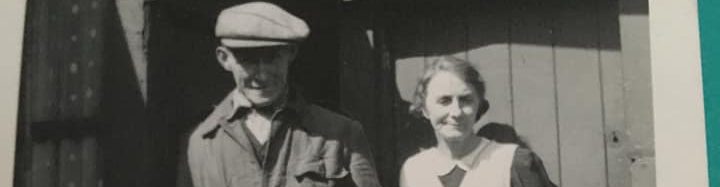


Anyone know the Grahan’s that lived at 14 Buddle Terrace in 1942. The record is their son Owen Gahan joining the Home Guard at Teesside In 1942
Lighting a coal fire with a breezer, newspaper worked as long as you were quick to pull it off before it burst into flames, posher miners homes might have had an iron breezer, made by the pit blacksmith as a sideline?

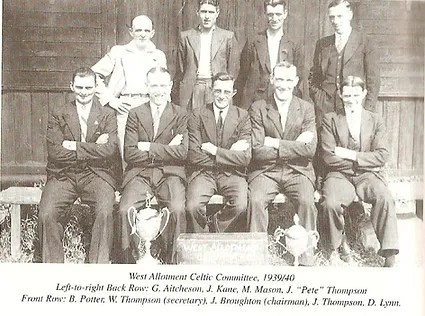
West Allotment Celtic Football Team
The history of football in the community of West Allotment goes back into the early years of the last century. Indeed, the first organised club to represent the village competed in the Byker & District League as early as 1908/09. Various clubs came and went over the ensuing years but the formation of the West Allotment Primitive Methodists (PMs) team after World War I was the key step leading to the creation of the present-day club. The PMs competed in the Forest Hall & District Churches’ League with reasonable success until 1928.
In 1928, the PMs began to feel the bite financially. Deeply-rooted in a coal-mining community and with the industry in turmoil following the General Strike, trying to maintain a local club was extremely difficult. So, facing ever-increasing debts, the decision was taken to wind-up the Primitive Methodists team and create a new club. That new club was effectively a merger of the old PMs team and West Allotment Juniors, another local club where it made sense to close-down, join forces and re-emerge stronger. So, the 1928/29 season saw West Allotment Celtic commence operations in the North Shields & District Churches’ League. Playing at Holystone and using old stables as changing-rooms, the club didn’t meet with instant success. However, eventually the League Cup was won in 1934/35 to provide Celtic with their first significant trophy.
The text and photos are from the club website, worth a visit at West Allotment Celtic Football Club



An article from the Remembering the Past website.
West Allotment – Life in a Mining Village
My grandfather walked each day to and from the pit, a distance of approximately five miles. We lived in the shadow of the pit heaps. Most of the small roads were laid with clinker. That’s where Catherine Cookson got her title ‘The Cinder Path’.
A number of small railways crossed the roads and wagons would rumble past taking coals to the staithes at Wallsend. A short distance from our house was the house of George Stephenson, famous for his engineering work and builder of the ‘Rocket’. At the point of the road where the wagons crossed was a small signal cabin where the signalman sat. He changed the signals by hand and stopped the traffic with his red flag and sent it on its way with his green one. My paternal grandfather was a miner for all his working life. He walked each day to and from the pit, a distance of approximately five miles. His life came to an end in the signal cabin where he suffered a heart attack well before his retirement was due.
My maternal grandfather was also a miner. He had fought in the Boer War and the Great War, but later lost an eye while working in the pit. He received no compensation for this, but, after a period of convalescence during which no money came into the house, he returned work. He couldn’t work at the coal face any more, so his wage was greatly reduced.
As far as I remember, miners were given free coal as part of their wages. Miner’s widows also had a less amount of free coal. They often sold this to the neighbours. They weren’t supposed to, but the colliery turned a blind eye.
Northumberland Miners’ Mutual Confident Association – History
A short excerpt from Wikipedia – The local Interest is that the secretary for the Algernon and Backworth Lodge lived at 17 Buddle Street, West Allotment. A Mr J.G. Forster.
The Northumberland Miners’ Association was a trade union.
The union was founded in 1864 to represent coal miners in Northumberland, following the collapse of a short-lived union covering both Northumberland and Durham miners. Originally named the Northumberland Miners’ Mutual Confident Association, it aimed for respectability, requiring high subscriptions and avoiding strikes. It did not affiliate to the national body, the Miners’ Federation of Great Britain, until 1907. In 1945, this became the National Union of Mineworkers, and the association became its Northumberland Area. This was dissolved in 2018.
The image is Burt Hall in Newcastle, the former HQ of the Northumberland Miners Association. Named after Thomas Burt M.P. as general secretary for 27 years, a very interesting local man and social reformer.


What was Cavilling? It seems to have been a common mining convention.
The cavil was an arrangement to allocate miners to specific workplaces which was
used in the Northumberland and Durham coalfield in Victorian and later times. Work assignments were made by a quarterly lottery, known as ‘the cavil’. On cavilling day, hewers’ names would be drawn out of the foreman’s hat, the order of draw determining the place at
which each pair of hewers would extract coal for the next three months. For the
miners, the result of the cavil was far from trivial. Geological conditions varied in
the mines, so that some places were easier to hew than others. Pay was by
piecework, so the luck of the cavil could move earnings potential up or down by
30% or more for the next quarter. Cavilling was still in use towards the middle of
the 20th century.
A very democratic system in some ways, more adept miners could have taken the more productive coal seams and made far more money, they excepted the cavil and took a lower pay to share things more evenly in their community.
<button onclick="window.scrollTo({top:0, behaviour: 'smooth'});">Scroll to top</button>